
Here is a number that should keep you up at night. Every five minutes you wait costs you. Your chances of converting that lead drop by over 80%.
That is not opinion. Years of research on solar lead response time prove it. Yet the average solar company takes over 24 hours. Some take three days.
If you are spending thousands of dollars every month on Google Ads, Facebook campaigns, and lead generation services, slow solar lead response time is quietly draining your marketing budget. We ran the numbers to show you exactly how much.
The Data on Solar Lead Response Time
Before we get to the cost calculations, let us look at what the research actually says about solar lead response time and conversion rates.
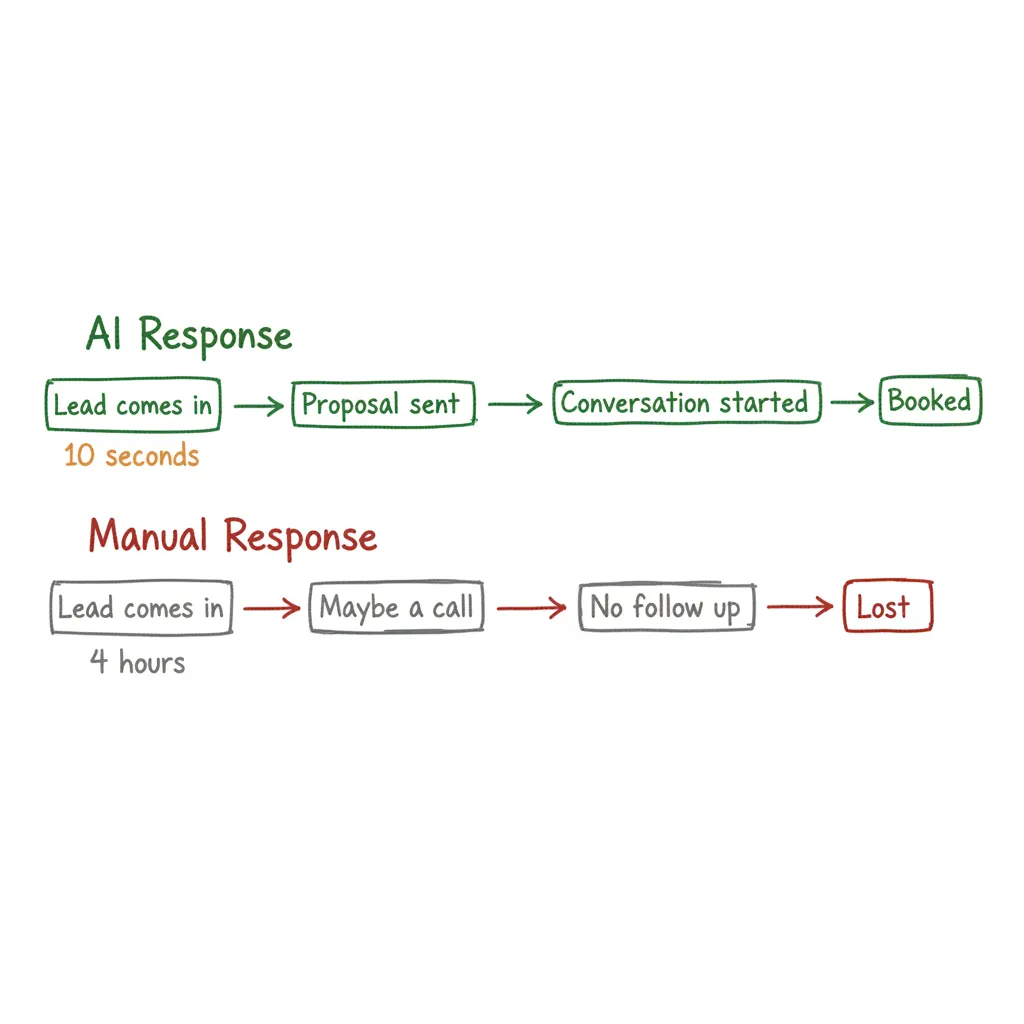
The Five-Minute Window
Lead Response Management research found a key stat. Contacting a lead within five minutes is 21 times more effective. Waiting 30 minutes destroys your odds. For solar lead response time, this matters even more. Solar is a considered purchase. Homeowners research multiple companies at once.
When someone fills out your form, they are motivated now. They are looking at an electric bill. They saw a neighbor's panels. They clicked your ad. That motivation fades fast. Solar lead response time is measured in minutes.
What Happens After Five Minutes
The dropoff in solar lead conversion after the first five minutes is dramatic:
- Under 1 minute: Highest possible conversion rate. The lead is actively engaged and expecting a response.
- 1 to 5 minutes: Still strong. The lead is likely still on your website or thinking about solar.
- 5 to 15 minutes: Conversion probability drops by 400%. The lead may have moved on to a competitor's site.
- 15 to 30 minutes: The lead has likely contacted or been contacted by another solar company.
- 30 minutes to 1 hour: You are now competing against companies who have already had full conversations with your lead.
- 1 hour or more: The lead has gone cold. Even if you reach them, the initial motivation has faded significantly.
- 24 hours or more: For all practical purposes, you have lost this solar lead. The homeowner has either chosen a competitor or lost interest entirely.
Why Solar Is Especially Sensitive to Response Time
Solar lead response time matters more than in many other industries for several specific reasons:
High competition. Most solar leads go to multiple companies. Homeowners reach out to two to four companies at once. First to respond wins. Solar lead response time is your advantage.
Emotional triggers fade. Going solar is a big decision. But the inquiry is emotional. A high bill. A neighbor's panels. That emotion fades fast. Solar lead response time captures the moment.
Long sales cycles. Solar sales take 30 to 60 days. The first responder has an advantage throughout. Faster solar lead response time sets the baseline.
Trust starts early. Homeowners judge you by responsiveness. Fast response signals professionalism. Slow solar lead response time makes them doubt you.
The Real Cost Calculator: What Slow Response Is Costing You
Let us run the numbers for a typical solar company. Adjust these figures to match your business, and the conclusions will still hold.
The Baseline Scenario
Your monthly numbers:
- Monthly ad spend: $10,000
- Average cost per solar lead: $50
- Total monthly leads: 200
- Current average solar lead response time: 2 hours
- Current conversion rate (lead to signed contract): 8%
- Average deal value: $25,000
- Leads converted: 16 (200 x 8%)
- Revenue generated: $400,000
- Cost per acquisition: $625 ($10,000 / 16 deals)
The Fast Response Scenario
Now let us see what happens when you improve your solar lead response time to under five minutes using AI-powered instant response:
Improved numbers (based on industry data):
- Monthly ad spend: $10,000 (same spend)
- Average cost per solar lead: $50 (same cost)
- Total monthly leads: 200 (same leads)
- New average solar lead response time: under 1 minute
- New conversion rate: 18% (conservative estimate based on 2x to 3x improvement)
- Average deal value: $25,000
- Leads converted: 36 (200 x 18%)
- Revenue generated: $900,000
- Cost per acquisition: $278 ($10,000 / 36 deals)
The Difference
| Metric | Slow Response (2 hours) | Fast Response (under 1 min) | Difference |
|---|---|---|---|
| Leads converted | 16 | 36 | +20 deals |
| Monthly revenue | $400,000 | $900,000 | +$500,000 |
| Cost per acquisition | $625 | $278 | -$347 saved |
| Annual revenue impact | $4,800,000 | $10,800,000 | +$6,000,000 |
"Every five minutes you wait to respond, your chances of converting that lead drop by over 80%."
Cost Calculator: What Are You Losing?
Use this table to estimate your own revenue loss from slow response. Assumes $50 cost per lead, $25,000 average deal value, 8% conversion at 2+ hours, and 18% conversion at under 5 minutes.
| Leads/Month | Avg Response Time | Conversion Rate | Deals Closed | Revenue | Leads Lost vs Fast Response | Revenue Lost |
|---|---|---|---|---|---|---|
| 50 | 2+ hours | 8% | 4 | $100,000 | 5 | $125,000 |
| 50 | Under 5 min | 18% | 9 | $225,000 | — | — |
| 100 | 2+ hours | 8% | 8 | $200,000 | 10 | $250,000 |
| 100 | Under 5 min | 18% | 18 | $450,000 | — | — |
| 200 | 2+ hours | 8% | 16 | $400,000 | 20 | $500,000 |
| 200 | Under 5 min | 18% | 36 | $900,000 | — | — |
The After-Hours Multiplier
Remember that 40% to 60% of solar leads come in outside of business hours. We break down this problem in detail in our guide on how to stop losing solar leads after hours. If your team only responds during 9 to 5, you are automatically giving slow responses to nearly half your leads.
Let us add that to the calculation:
- 200 monthly leads x 50% after hours = 100 after-hours leads
- After-hours solar lead response time without AI: 12 to 16 hours (until next business day)
- After-hours conversion rate at that response time: approximately 2%
- Leads converted from after-hours: 2
- Solar lead response time: under 1 minute
- Conversion rate: 18%
- Leads converted from after-hours: 18
"At $25,000 per deal, that is $400,000 per month in recovered revenue — just from responding to after-hours leads instantly."
Why Most Solar Companies Still Respond Slowly
If faster response means more revenue, why is solar lead response time still slow? There are several reasons.
Manual Processes
Most companies use manual lead routing. A form triggers an email to a manager. The manager assigns it. The rep calls when free. Each handoff adds delay to solar lead response time.
Understaffed Sales Teams
Reps juggle many tasks. Prospecting. Consultations. Site visits. Proposals. Follow-up. New leads compete with current work. Solar lead response time suffers when reps are stretched thin.
No After-Hours Coverage
As discussed above, most solar companies simply do not have anyone available outside of business hours. They accept that after-hours leads will wait until morning, not realizing the massive revenue impact of that delay on their solar lead response time.
Lack of Visibility Into the Problem
Many owners do not track solar lead response time. They assume "pretty quickly." When they check the data, they are shocked. Average solar lead response time is hours, not minutes.
How to Fix Your Solar Lead Response Time
Solution 1: Measure What You Have
You cannot improve what you do not measure. Start tracking your actual solar lead response time for every lead. Most CRM systems can log when a lead enters the system and when the first response is sent. If yours does not, add timestamps manually for two weeks to establish a baseline.
Solution 2: Set a Response Time SLA
Establish a clear standard for your team: every new solar lead gets a response within five minutes during business hours. Make this a measurable KPI that you track and review weekly. Hold your team accountable to it.
Solution 3: Implement AI-Powered Instant Response
For true instant response — especially after hours — you need AI. An AI-powered platform like Pocket Side AI responds to every solar lead within seconds, 24 hours a day, seven days a week. The AI engages the homeowner in natural conversation, qualifies them, answers common questions, and even generates proposals. Your solar lead response time drops from hours to seconds without adding headcount.
Solution 4: Optimize Your Lead Routing
If you are using manual lead assignment, switch to automated round-robin distribution with escalation rules. If a rep does not engage a lead within three minutes, it automatically routes to the next available rep. Eliminating manual handoffs can cut your solar lead response time by 70% or more during business hours.
Solution 5: Use Multi-Channel Response
Email is slow. Phone calls go to voicemail. Text and WhatsApp Business get seen immediately. Configure your system to respond on the channel most likely to get a fast reply. For most solar leads in 2026, that means WhatsApp or text message. These channels have dramatically faster solar lead response time engagement than email.
Solution 6: Track and Report Weekly
Make solar lead response time a standing item in your weekly sales meeting. Show the team their average response time, their fastest and slowest responses, and how it correlates to conversion rates. When reps see the direct link between speed and commission, behavior changes fast.
The Compound Effect of Fast Solar Lead Response Time
Faster solar lead response time does not just improve your conversion rate. It creates a compound effect that improves your entire business:
Better lead quality perception. When you respond fast and convert more leads, your marketing team's cost per acquisition drops. Leads that seemed "low quality" were actually just going cold because of slow solar lead response time.
Higher rep morale. Sales reps who work pre-qualified, engaged leads close more deals and earn more commission. This reduces turnover and recruitment costs.
Stronger brand reputation. Homeowners talk. When someone has an amazing experience with fast, professional solar lead response, they tell their neighbors. Referrals increase.
More accurate forecasting. When your solar lead response time is consistent and your conversion rate is stable, your revenue forecasts become reliable. You can plan growth with confidence.
Competitive moat. Most solar companies will not fix their solar lead response time. By solving it now, you create an advantage that is difficult for competitors to replicate quickly.
The Bottom Line: Every Minute Costs You Money
"Only about 10% of solar companies respond within the recommended five-minute window. This creates an enormous competitive advantage for those that do."The math on solar lead response time is unambiguous. Faster response means more conversions, more revenue, and lower acquisition costs. Slow response means wasted ad spend, lost deals, and frustrated homeowners who buy from your competitors.
To build a system that captures every lead, check out our solar sales pipeline management guide and our comparison of the top AI software tools for solar companies.
The solar companies that dominate their markets in 2026 are the ones that treat solar lead response time as their most critical sales metric. They do not just try to respond faster — they eliminate the delay entirely with AI-powered instant response.
If you are spending money to generate solar leads but taking hours to respond, you are not just leaving money on the table. You are actively paying to hand your leads to competitors.
Want to see the impact on your specific numbers? Book a free demo with Pocket Side AI and we will calculate exactly how much revenue you are losing to slow solar lead response time — and show you how to fix it in days, not months.
Frequently Asked Questions
What is the ideal solar lead response time?
The ideal solar lead response time is under five minutes, with under one minute being the gold standard. Research shows that responding within five minutes makes you 21 times more likely to qualify the lead compared to responding in 30 minutes. AI-powered platforms can achieve solar lead response time of under 60 seconds, 24 hours a day.
How much does slow solar lead response time really cost?
For a typical solar company spending $10,000 per month on lead generation, improving solar lead response time from two hours to under five minutes can increase monthly revenue by $300,000 to $500,000 or more. The exact impact depends on your lead volume, deal size, and current conversion rate.
Can AI really respond to solar leads instantly?
Yes. AI-powered platforms like Pocket Side AI respond to new solar leads within seconds using intelligent conversation agents. These agents can engage homeowners in natural dialogue, answer common solar questions, qualify leads, and even generate preliminary proposals — all without human involvement and with instant solar lead response time.
What is the average solar lead response time in the industry?
The average solar company takes over 24 hours to respond to a new lead. Many take two to three days. Only about 10% of solar companies respond within the recommended five-minute window. This creates an enormous competitive advantage for companies that prioritize fast solar lead response time.
How do I track my solar lead response time?
Most modern CRM systems can track the time between lead creation and first response. If your current tools do not track solar lead response time automatically, manually log timestamps for two weeks to establish your baseline. Track this metric weekly in your sales meetings and set improvement goals.