It is 9:47 PM on a Tuesday. A homeowner just watched a TikTok about how their neighbor cut their electric bill in half with solar panels. They are motivated. They Google "solar installers near me," find your company, and fill out your contact form.
Your office is closed. Nobody responds.
By 9 AM Wednesday, that same homeowner has already spoken to two of your competitors who responded within minutes. Your lead is gone before your team even opened their laptops.
This is not a hypothetical scenario. Solar leads after hours are being lost by companies every single night, and the data proves just how costly losing solar leads after hours really is. (Want the exact dollar figures? Read our breakdown on the real cost of slow lead response in solar.)
The After-Hours Lead Problem in Solar
Here is what most solar company owners do not realize about solar leads after hours. A massive portion of leads arrive outside business hours. Studies show that 40% to 60% of online leads come in between 6 PM and 8 AM. Evenings and weekends are peak times. That is when homeowners look at electric bills. That is when they think about solar leads after hours.
The challenge with solar leads after hours is obvious. Your sales team works 9 to 5, but your solar leads after hours do not follow that schedule.
Why Speed to Lead Matters More Than Anything in Solar Sales
The research on lead response time is staggering:
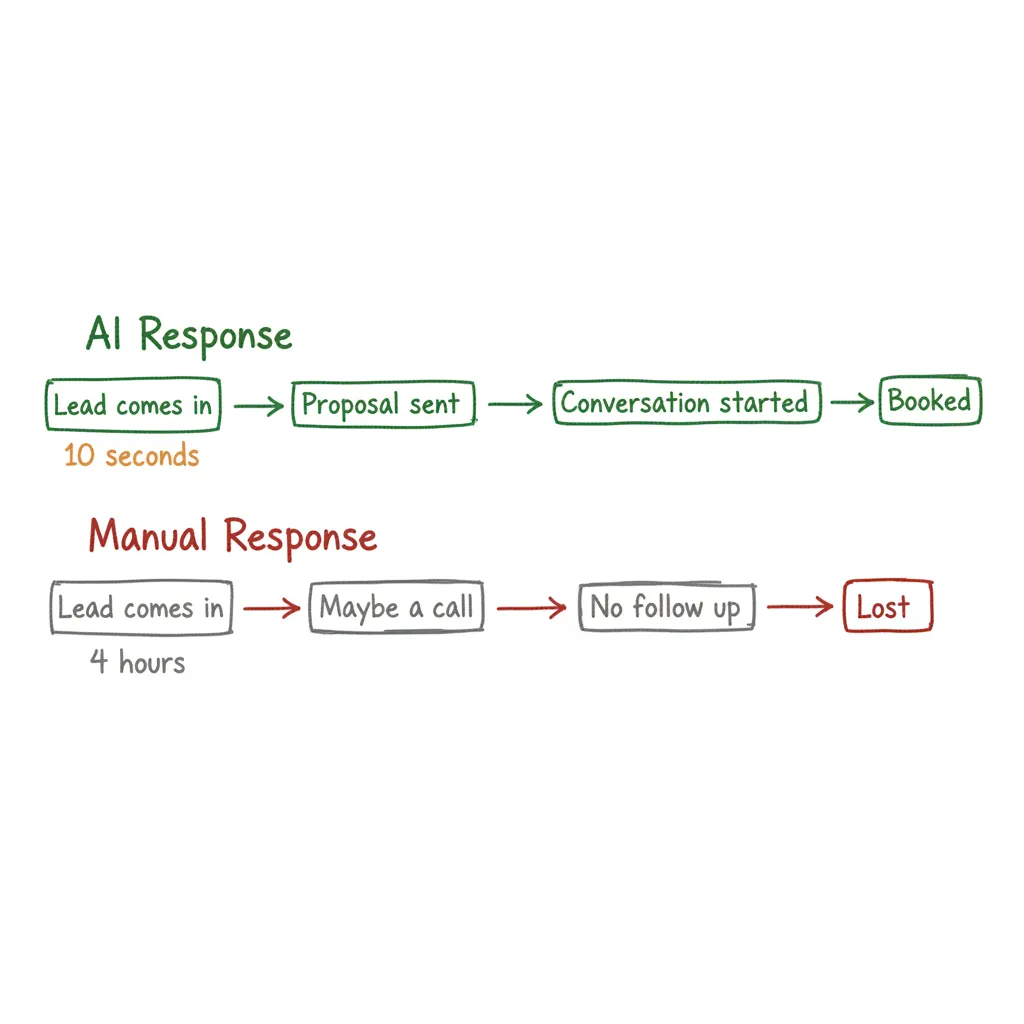
- Responding within five minutes makes you 21 times more likely to qualify that lead compared to responding in 30 minutes
- After 10 minutes, the odds of qualifying a lead drop by 400%
- 78% of customers buy from the company that responds first
- The average solar company takes over 24 hours to respond to a new lead
#### Response Time vs Conversion Rate
| Response Time | Conversion Likelihood | What Happens |
|---|---|---|
| Under 5 minutes | 21x more likely to qualify | Lead is actively engaged, expecting a response |
| 5 to 30 minutes | 4x more likely than baseline | Lead is still browsing, may be talking to competitors |
| 30 minutes to 1 hour | 1.5x more likely than baseline | Lead is losing interest, momentum fading |
| Over 1 hour | Baseline | Lead has gone cold or chosen a competitor |
What This Actually Costs Your Solar Business
Let us do some quick math that every solar company owner should see.
Say you spend $50 per lead through Google Ads or Facebook campaigns. You generate 200 leads per month. If 45% of those come in after hours (a conservative estimate), that is 90 leads per month arriving when nobody is available to respond.
If your after-hours conversion rate is just 2% instead of your normal 15% during business hours, you are converting only two of those 90 leads instead of the 13 you could be converting.
That is 11 lost deals per month. At an average installation value of $25,000, you are leaving $275,000 in potential revenue on the table every single month.
And you are still paying $4,500 per month for those 90 leads that mostly go nowhere.
The Old Solutions (And Why They Do Not Work)
Solar companies have tried several approaches to solve the after-hours problem. Most of them fall short.
Hiring Night Staff or Outsourced Call Centers
When solar companies realize they are losing solar leads after hours, they hire night staff. The problem is cost. A dedicated rep costs $3,000 to $5,000 per month. Call centers are cheaper. But they are bad at solar conversations. They read scripts. They cannot answer technical questions. They frustrate customers more than they help.
Chatbots on Your Website
When trying to capture solar leads after hours, chatbots were the first wave. The issue? Most feel robotic. They handle only basic questions. They create friction. They only work if the lead stays on your website. Many do not.
Auto-Reply Emails
Another approach to solar leads after hours is auto-reply emails. "Thanks for your inquiry" is better than silence. But it does not engage the lead. It does not qualify them. It does not answer questions. It builds no momentum. It is a placeholder, not a solution for solar leads after hours.
Voicemail and Call-Back Promises
The worst approach to solar leads after hours is voicemail. "Leave a message. We will call you back." By morning, three competitors have already responded. Voicemail is where solar leads after hours go to die.
The Modern Solution: AI-Powered Lead Response
The solar companies consistently winning the battle for solar leads after hours in 2026 are using AI-powered conversation agents. In fact, the top AI software tools for solar companies all address this problem in some form. Not chatbots. Not auto-responders. Actual AI agents that can hold natural, intelligent conversations with potential customers in real time.
Here is how capturing solar leads after hours with AI works in practice:
How AI Solar Lead Response Actually Works
Step 1: Instant engagement. When a lead comes in — through your website, a Facebook ad, Google, or a referral link — the AI agent sends a message within seconds. On WhatsApp, this feels natural and personal because it is the same app the homeowner uses to text their family.
Step 2: Intelligent conversation. The AI does not just acknowledge the lead. It asks the right questions: What is your current monthly electric bill? Do you own your home? Are you interested in purchasing or leasing? What is your timeline? It handles these conversations naturally, adjusting its responses based on what the homeowner says.
Step 3: Qualification and scoring. Based on the conversation, the AI automatically qualifies the lead. Is this person a serious buyer with the right property type and budget, or are they just casually browsing? Your sales team wakes up to a prioritized list of hot leads, not a pile of unqualified form submissions.
Step 4: Proposal delivery. The most advanced solar AI software for solar companies can go even further. Using the homeowner's address and satellite imagery, the system generates a preliminary solar proposal and delivers it during the same conversation. The homeowner goes to bed with a personalized proposal on their phone. Your competitors have not even responded yet.
Step 5: Human handoff. When the solar leads after hours are qualified and ready for a deeper conversation, the AI seamlessly hands off to your sales team with full context. Your rep knows exactly what was discussed, what the homeowner's concerns are, and where they are in the buying process.
Real Results Solar Companies Are Seeing
Solar companies using AI to capture solar leads after hours are reporting dramatic improvements:
- Lead response time drops from hours to seconds — even at 2 AM on a Saturday
- After-hours conversion rates jump 3x to 5x — because leads are engaged immediately
- Sales team productivity increases 40% — reps spend time on qualified leads, not cold callbacks
- Cost per acquisition drops 30% to 50% — same ad spend, more conversions
- Customer satisfaction scores improve — homeowners appreciate fast, helpful responses
How to Implement AI Lead Response for Your Solar Company
If you are ready to stop losing solar leads after hours, here is a practical roadmap for capturing solar leads after hours:
Step 1: Audit Your Current Lead Flow
Before changing anything, understand your current situation. Pull data on when your leads come in, how long it takes to respond, and what your conversion rate looks like by time of day. Most solar companies are shocked by what they find.
Step 2: Choose the Right AI Platform
Not all AI lead response tools are created equal. For solar companies, you want a platform that understands the solar sales process, can handle industry-specific questions, and integrates with how your customers actually communicate.
Pocket Side AI was built specifically for this. Its WhatsApp-based AI agent understands solar terminology, qualification criteria, and the typical homeowner buying journey. It is not a generic chatbot repurposed for solar — it is purpose-built for the industry.
Step 3: Set Up Your Knowledge Base
The best AI agents are only as good as the information they have access to. Feed the system details about your company, your service areas, your pricing models, your financing options, and answers to the 50 most common questions your sales team gets. The more context the AI has, the more natural and helpful its conversations will be.
Step 4: Define Your Qualification Criteria
Work with your sales team to define what makes a qualified lead for your company. The AI should know your ideal customer profile — homeowner versus renter, minimum electric bill, service area, timeline, and any other factors that separate serious buyers from tire-kickers.
Step 5: Test and Refine
Start with a pilot. Run the AI agent alongside your existing process for two to four weeks. Compare response times, lead quality, and conversion rates. Adjust the conversation flows based on what you learn.
Common Concerns About AI Lead Response
"Will homeowners know they are talking to AI?"
Modern AI agents are remarkably natural in conversation. Most platforms allow you to be transparent about the AI while still delivering a great experience. Many homeowners actually prefer the instant response over waiting for a human callback.
"What if the AI says something wrong about our services?"
Quality AI platforms like Pocket Side AI pull answers from your approved knowledge base, not from generic internet data. You control what the AI knows and says. If a question falls outside the knowledge base, the AI acknowledges that and routes the conversation to your team.
"What about leads that need complex technical conversations?"
The AI handles initial engagement and qualification, not the full sales process. When a lead needs detailed technical discussion — roof assessments, complex shade issues, specific engineering questions — the AI hands off to your team with full conversation context. It is a first responder, not a replacement for your sales expertise.
Stop Leaving Money on the Table
Every night your phones are off, solar leads after hours are flowing into your competitors' AI agents who are having conversations, qualifying leads, and sending proposals. (Speaking of proposals — learn why 60% of solar proposals never get opened and how to fix it.) The solar companies that figure this out are capturing market share from those that do not.
The math is simple. If you are generating solar leads after hours and not responding instantly, you are paying for leads you will never close. Building a proper solar sales pipeline starts with capturing every solar lead after hours. AI-powered lead response is the difference between burning your ad spend and turning it into revenue around the clock.
Quick Wins: Start Capturing After-Hours Leads This Week>
1. Audit your lead timestamps. Pull the last 30 days and check what percentage arrive after 6 PM. You will likely find 40% or more.Ready to stop losing leads while you sleep? See how Pocket Side AI's 24/7 WhatsApp agent works for solar companies — book a free demo and we will show you exactly how many after-hours leads you are missing today.
2. Set up instant auto-acknowledgment. Even a simple "We got your inquiry, someone will reach out shortly" beats silence.
3. Switch to WhatsApp or SMS responses. Email auto-replies have 35% open rates. WhatsApp has 98%.
4. Test an AI agent for two weeks. Run it alongside your existing process and compare conversion rates.
5. Track cost per after-hours lead. Calculate how much you are spending on leads that go unanswered overnight.
Frequently Asked Questions
How quickly should a solar company respond to a new lead?
Industry data shows that responding within five minutes is critical. After five minutes, the probability of qualifying that lead drops dramatically. The best solar companies respond in under 60 seconds using AI-powered lead response.
What percentage of solar leads come in after business hours?
Studies show that 40% to 60% of online solar leads are generated outside of standard 9 to 5 business hours. Evenings and weekends are peak research times for homeowners considering solar installation.
Is AI lead response expensive for small solar companies?
AI lead response platforms are significantly more cost-effective than hiring after-hours staff. Most solar companies find that the increase in conversions from instant lead response more than pays for the platform within the first month.
Can AI handle solar-specific questions from homeowners?
Yes. Purpose-built solar AI platforms are trained on solar industry knowledge including panel types, financing options, net metering, tax incentives (including SEAI solar electricity grants), and installation timelines. They can answer the most common homeowner questions accurately and naturally.
Will AI replace my sales team?
No. AI handles the initial response, qualification, and engagement — especially during after-hours. Your sales team remains essential for consultations, site visits, system design discussions, and closing deals. AI makes your team more effective by giving them pre-qualified, engaged leads to work with.